Blog

Your blog category

Inpatient vs Outpatient Care, What is the Difference?

Blog

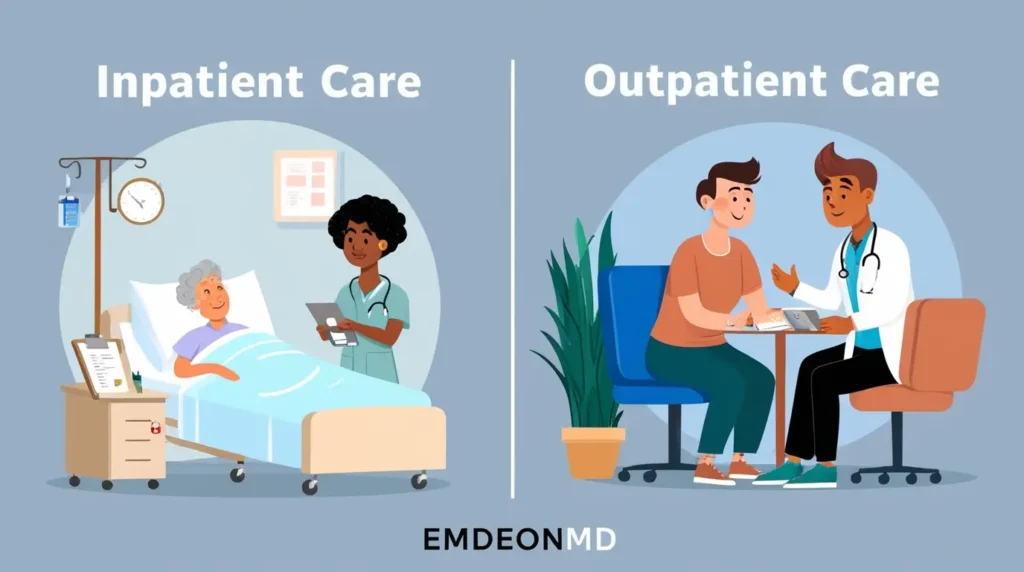
Introduction Navigating the healthcare system can be complex, especially when it comes to understanding the types of care available. Two primary categories that patients often encounter are inpatient and outpatient care. Grasping the difference between these two forms of medical treatment is essential for patients, caregivers, and healthcare providers alike. This article delves into the definitions, key differences, and considerations for choosing between inpatient and outpatient care. Definitions What is Inpatient Care? Inpatient care refers to medical treatment that requires a patient to be admitted to a hospital or healthcare facility. Patients typically stay overnight or for an extended period, depending on their medical needs. Inpatient care is necessary for more serious health issues that require continuous monitoring, specialized equipment, or intensive treatment. What is Outpatient Care? Outpatient care, on the other hand, involves medical procedures or treatments that do not necessitate an overnight stay in a healthcare facility. Patients receive care in a clinic, office, or hospital and can return home on the same day. Outpatient care is often used for routine check-ups, minor surgical procedures, and rehabilitation therapies. Key Differences Understanding the distinctions between inpatient and outpatient care can help patients make informed decisions about their health. Here are some key differences: Inpatient Care Inpatient care is essential for patients who require close observation and complex treatment. Common settings for inpatient care include hospitals and specialized treatment facilities. Overview of Services and Settings Inpatient care encompasses a wide range of services, including: Common Procedures and Treatments Patients may undergo various procedures while hospitalized, such as: Advantages and Disadvantages Advantages Disadvantages Outpatient Care Outpatient care is designed for patients who do not require extended hospital stays. It provides flexibility and accessibility, making it an attractive option for many individuals. Overview of Services and Settings Outpatient care can occur in various settings, including: Common Procedures and Treatments Some typical outpatient services include: Advantages and Disadvantages Advantages Disadvantages Choosing Between Inpatient and Outpatient Care When deciding between inpatient and outpatient care, several factors come into play: Conclusion Understanding the differences between inpatient and outpatient care is crucial for making informed healthcare decisions. Each type of care has its own advantages and disadvantages, tailored to different medical needs. By considering factors such as the severity of the condition, recommendations from healthcare providers, and personal preferences, patients can choose the best option for their treatment. Making informed decisions leads to better health outcomes and a more satisfactory healthcare experience. FAQs

Inpatient vs Outpatient Care, What is the Difference? Read More »

ECW Billing Services

ECW Billing Services: Streamlining Your Practice’s Revenue Cycle

Blog

Science and technology have been a revolutionary advancement leading this era in many aspects, transforming the whole world into a scientific era. Scientific advances in healthcare have been a helping hand since their emergence, while now IT solutions have taken the whole healthcare system to the next level. This blog post discusses one of the most recent and advanced software programs making its way into patient management and electronic health records EHR.  Have you come across any such software? Looking to introduce one at your place. We are here to help you find the best one. What is EclinicalWorks? Yes you heard it right, Eclinicalworks is one of the best and advanced softwares currently in the healthcare industry, making its way into the billing industry. How does it works?  EclinicalWorks is a healthcare IT company facilitating healthcare maintenance of electronic health records EHRthat in turn helps in efficient patient management through reported, organized data for better tracking of appointments and progress along with follow-ups. EClinicalWorks billing services​ are becoming common in the market, in which this software ensures streamlined billing.ECW revenue cycle management​ is one of the prime features of this software, making it practical and acceptable among healthcare professionals in where EHR integration is significantly important in managing and maintaining patient records. ECW billing services overview To streamline the whole revenue cycle management of billing services, eClinicalWorks is here to help out. Elcinal Works offers EHR integration that roots its way into efficient and accurate billing of medical services, ensuring the best billing and RCM practices. Eclinicalworks billing services are more acceptable and trusted among the community due to the characteristic features that it provides in its integrated revenue cycle management by connecting its centralized billing platform for efficient billing and reimbursements. Along with the revenue cycle management, it assures regular stability, security, and compliance. Improve performance through eClinicalWorks revenue cycle management.  Are you looking for automated, streamlined billing software with patient management and electronic health records EHR for patients by integrating administrative and clinical tasks, in turn streamlining the entire billing process? Eclinicalworks got you covered in one software with its premium features for managing patient records with integrated billing and revenue cycle, ensuring an integrated system, facilitating multiple healthcare services on one platform, which makes it unique and competitive among the software. Eclinicalworks offers  medical billing optimization​ , lowering administrative burden, lowering risks of denials, in which automated claims processing monitors the billing process for performance analytics and revenue growth. Perk of low prices Do you have any idea about what other perks and benefits does Eclinicalworks offer? Eclinicalworks offers premium and high quality EHR integration with stramling billing services along with enhanced patient care and improved management , with automation and analytics.  Most people don’t go for high featured services, why? The most concerning issue that hinders easy choosing is the cost effectiveness of service.EclinicalWorks offers best prices in the market full of softwares, with best prices no compromise is being done on the service quality. It ensures prime and high-quality services with market-best prices. Specialty-focused RCM services Another query that is most common among professionals looking for RCM services is whether eClinicalWorks offers specialty-focused services. Yes, Elcinal Works offers specialty-focused revenue cycle management RCM services to its clients. According to reported data about dermatology billing practice, it has shown a 99% collection rate in the case of eClinicalWorks implementation, which shows a proven representation of revenue growth. Patient eligibility verification through automated AI-driven software ensures valid and accurate verification, serving a prime base of billing operations along with a customized dashboard concerning a certain specialty, ensuring highly specific and customized billing solutions through an integrated software supporting full service of self-service RCM models. ECW’s role in revenue cycle services Eclinicalworks is a highly specialized and advanced tool used in healthcare for the provision of integrated revenue cycle services for enhancing financial performance, along with reducing administrative and clinical burden on the human workforce, along ensuring improved patient efficacy. Some key roles of implementing this software cover varied types of RCM models based on client needs and comfort, in which self-service ensures all basic to advanced parts of billing through a stepwise approach, while full service covers denial management, claim processing, to enhance patient care. Automated claims processing​ & payment posting are facilitated by AI-driven tools for better accuracy and lower risk of errors, in turn lowering denials and rejections. Process of eClinicalWorks billing Eclinicalworks is concerned with streamlining the billing and revenue cycle, in which an AI-driven tool helps in the whole operational process from the initial steps to the final steps. Have you wondered if there is any difference in the process of clinical work billing? No, as far as the billing process is concerned, no variance could be observed in the Eclinal Works software. It provides their clients the same billing experience but with highly advanced and focused service with automated tracking, lessening time in billing of claims, which leads to delayed remittances, compromising patient financial statements, but EclinicalWorks resolves all these problems in one go. EmdeonMD specialized support Looking for an outsourcing billing service that could give you the best Eclinicalwork experience? No need to go anywhere here, EmdeonMD is here to help you out. Our professional experts offer premium services with advanced clinical work software, ensuring the best experience, with proven growth and maximum billing rates. Have any uncertainty, book your consultations with our professional expert for brief and comprehensive guidance about our top-notch services. Still worried, whether to opt or not. Don’t wait to book your free consultations, let’s make a difference in your services with our expert-guided billing and RCM services available at best rates. Frequently asked questions (FAQs)

ECW Billing Services: Streamlining Your Practice’s Revenue Cycle Read More »

Podiatry Billing Services

Podiatry Billing Services: Optimizing Revenue for Your Practice

Blog

Podiatry billing services are a comprehensive approach to streamline revenue cycle management and coding, ensuring timely reimbursement of claims. Podiatry services handle every step of billing concerned with foot and ankle complications offered by a podiatrist. All your concerned queries are catered to in this blog post with a comprehensive overview of what podiatric billing is, along with key components, with a brief explanation of the significance of accurate podiatry billing services. Podiatry billing services Podiatry billing services are specialty-based billing and coding services concerned with ankle or foot/ leg injuries, in which experts provide medical services. Podiatry medical billing is a specialized billing service in which strict rules are to be followed while coding and billing podiatry medical services, which makes it more challenging and complicated. Regulatory compliance is a major part of this billing service, which can only be catered by expert professionals having updated knowledge along with expertise in podiatry billing services to avoid delays or rejections by the insurance company. Look for an expert outsourced billing company that could offer you the best services with proven results. Significance of an accurate podiatry billing service Podiatry billing and coding services are highly significant and crucial in the healthcare system as they cater to a highly conserved part of the body on which the whole locomotion and mobility depend, which directly influences the quality of care of the suffering individual. Accurate podiatry billing services are highly crucial for ensuring a trustworthy patient experience along with timely and valid reimbursements, ensuring streamlined billing and RCM process. Like other specialties, billing services, accurate podiatry billing services have the same importance in the healthcare system and the billing industry.  Have a look at some highlighted important key roles of accurate podiatry services play in the healthcare system concerning provider services and patients: Podiatry billing services with accurate coding and billing of podiatry-related medical services ensure the financial stability of patients, helping him/her to get reimbursed in time through a streamlined billing procedure that manages smooth cash flow through organized administrative work of the professional team. Looking for a professional billing team for your podiatry billing services, EmdeonMD billing experts are available to ensure your best experience with proven and satisfactory billing solutions. Our team serves the best services, focusing on smooth and streamlined billing services, with high-quality revenue cycle management, assuring fiscal stability to the client along with revenue growth. Podiatry billing services ensure regular compliance, assuring compliance with all guidelines provided by the regulatory authorities, like the Centers for Medicare Services CMS, AMA, or related authorities responsible for assuring guidelines to the community to ensure uniform rules and regulations while billing, coding, and RCM of podiatry services, which ensures liability to get reimbursed against the accurately submitted claims.  If someone does not comply with regulatory compliance, what happens? Non-compliance with the regulatory guidelines leads to penalties and prohibitions that depend on the type of non-regulation, in which denials and rejections are most prevalent, which affect overall billing services. Accurate and valid podiatry billing practices are highly significant in patient satisfaction, as provision of accurate billing solutions assures timely reimbursements, ensuring financial stability, which in turn improves trust and satisfaction, leading to enhanced patient care. High-quality billing services ensure transparent and predictable costs for patient understanding about insurance coverage, lessens frustration with insurers due to surprise unpaid balances that improve communication and support with improved patient and physician relationships leading to enhanced patient care.  EmdeonMD offers the best experience, ensuring client preferences, aiming to provide premium services with the best experience through the provision of trustworthy and satisfactory solutions. One of the prime and most challenging parts of any medical service in terms of billing is effective billing services, considering it as the most challenging part of medical billing. In podiatry billing service, efficient claim submission is highly dependent on accurate usage of CPT, HCPC, S and ICDs codes along with claim submission in a timely and accurate manner, and validation aligns with regulatory compliance.   Are you facing issues in podiatry billing services? What to do? Outsourcing podiatry billing services is the solution to this issue. Outsourced billing services are more accurate with minimized denial risks ensured by valid and ensured claim submission in speculated time. Accurate billing solutions are more concerned with efficient billing solutions while it also serves a role in provider practices, ensuring a developmental role in decision making on basis of revenue performance, giving an overview about per procedural revenue, and overall performance, helps in efficient data management with proper recording and documentation for training improvement in the treatment or need for modification in the treatment plan, in turn directly influencing the medical decision making of professionals, which helps in enhancing patient care.  Key components in podiatry billing Podiatry medical billing has similar components to those of other services, varying in terms of CPT, ICDs, and reimbursement guidelines, only specialized to foot care offered by podiatrists. Medical coding is a prime component in the whole billing of podiatry billing services, as updated CPT, ICDs, and their reimbursement rate policies are required for accurate billing of this service. Here is a detailed list of key companies that podiatry billing services cover: EmdeonMD optimizing revenue for your practice As far as offering billing solutions is concerned, EmdeonMD serves the best outsourcing services to its clients with professional experience. If you want to take this experience, look up our service details available on our official website,  along with your queries, our blog post and articles will get you covered. Still not sure? Our professional experts’ free consultations are arranged to give you the best experience with professional guidance. Book your consultations now! Frequently asked questions (FAQs)


Podiatry Billing Services: Optimizing Revenue for Your Practice Read More »

Understanding the Importance of ICD Codes in Healthcare

Blog

Introduction The International Classification of Diseases (ICD) is a critical coding system utilized in healthcare worldwide to categorize diseases, symptoms, and various health-related conditions. In the United States, the ICD plays a fundamental role in the healthcare system, serving purposes that extend beyond mere classification. Understanding the most commonly used ICD codes is essential for healthcare professionals, patients, and anyone interested in the healthcare industry. This article explores the significance of ICD codes, their applications, and highlights the top ten codes frequently used in the U.S. What are ICD Codes? ICD codes are alphanumeric codes that assign a specific label to diseases and health conditions. Developed by the World Health Organization (WHO), the ICD coding system has been in use since the late 19th century and has undergone several revisions to accommodate new medical knowledge and practices. The latest version in use in the U.S. is ICD-10, which was implemented in October 2015, replacing the older ICD-9 system. ICD codes provide a standardized method for documenting diseases and conditions, making it easier for healthcare providers to share information, perform research, and ensure accurate billing. Importance of ICD Codes ICD codes serve several crucial functions within the healthcare system: Billing and Reimbursement One of the primary uses of ICD codes is for billing purposes. Healthcare providers must document diagnoses accurately to receive payment from insurance companies. Each diagnosis correlates with a specific code, and incorrect coding can lead to denied claims and financial losses for healthcare providers. Patient Records The use of standardized ICD codes helps maintain clear and consistent patient records. This standardization is critical for continuity of care, especially in settings where multiple healthcare professionals may be involved in a patient’s treatment. When patient records are coded properly, providers can easily access a patient’s medical history, which can significantly impact clinical decision-making. Epidemiological Research Public health officials and researchers rely on ICD codes to track disease prevalence and patterns. By analyzing data from these codes, they can identify trends, monitor outbreaks, and evaluate the effectiveness of public health interventions. This research is vital for informing policies and allocating resources effectively. Quality of Care The evaluation of treatment outcomes based on ICD coding allows healthcare organizations to improve care quality. By analyzing how different conditions are treated and the outcomes of those treatments, providers can identify best practices and areas needing improvement, ultimately leading to better patient outcomes. Regulatory Compliance ICD codes also play a role in regulatory compliance. Healthcare organizations must adhere to coding guidelines to meet standards set by regulatory bodies, including Medicare and Medicaid. Accurate coding is essential for compliance with laws and regulations governing healthcare delivery. Top 10 Commonly Used ICD Codes Here are ten of the most commonly used ICD codes in the U.S. healthcare system, along with brief descriptions: The Process of Assigning ICD Codes The process of assigning ICD codes begins during patient visits when healthcare providers document symptoms, diagnoses, and treatment plans. Coders then review this documentation to determine the correct ICD codes. Accurate coding is crucial; errors can lead to incorrect billing and misrepresentation of a patient’s health status. Training and education in coding practices are essential for healthcare professionals. Ongoing education ensures that coders stay updated on changes in the coding system and understand the nuances of various diagnoses. Future of ICD Coding As healthcare technology evolves, so does the ICD coding system. Future developments may include codes for emerging health conditions, telehealth services, and personalized medicine. The integration of advanced technologies like artificial intelligence and machine learning may also improve coding accuracy and efficiency, making it easier for providers to document diagnoses correctly. Conclusion ICD codes are a fundamental component of the U.S. healthcare system, influencing everything from billing to patient care quality. Understanding these codes is essential for healthcare professionals and patients alike. As the healthcare landscape continues to change, staying informed about ICD codes will help improve health outcomes and foster better communication between patients and providers. FAQs

Understanding the Importance of ICD Codes in Healthcare Read More »

Revenue Cycle in Healthcare Management

When Does the Revenue Cycle Begin in Healthcare Management?

Blog

Revenue cycle management RCM is a prime focus in medical billing, serving a crucial role in managing operational services in the healthcare system. Medical billing is the main component in which the revenue cycle is being practised by professionals in the billing industry that requires professional expertise and educational background for the provision of accurate and high-quality services, ensuring timely and accurate billing and reimbursements of rendered medical services. The main concerning thing in medical billing of rendering medical services to enrolled patients is when the revenue cycle begins in healthcare management. How does it progress, and does this timeframe matter in billing? All these questions are answered in this blog post. Overview of revenue cycle Revenue Cycle is a comprehensive process of managing administrative and clinical functions concerned with medical billing, including medical coding, claim submission, payment, followed by revenue generation, and ensuing financial performance analytics. Revenue cycle management RCM covers all basic to advanced step involved in medical billing initiating form initial patient registration, followed by insurance verification, medical coding and claim submission of patients encounter with the respective healthcare provider, ensuring timely reimbursement by the payers in an integrated system handled by expert RCM specialist having professional experience and certification along with experience in real time settings. Revenue cycle management RCM is an extensive approach to managing the revenue cycle. Role of staff training and education in RCM As revenue cycle management RCM is a highly significant component of medical billing that requires expertise in efficient handling of administrative and clinical tasks which regular training and educational programs must be arranged regularly for staff to ensure updated and advanced tool and software usage for the provision of accurate and complaint services with minimise risks of denials and rejections by the insurers. Along with these key roles of educational programs, accurate medical coding followed by proper claim submission is a key feature, in which patient communication is enhanced by trained staff focusing on serving the best patient experience. When does the revenue cycle begin in healthcare management? Is RCM benign forced any time in the whole billing process? Revenue cycle management RCM initiates with initial step of medical billing for ensuring validated and verified patient information covering insurance eligibility and verification along with other demographics and related details, acting as crucial component from initial step ensuring all necessary information to be accurate valid and verified on early basis to avoid any late risks of errors or denials. The most prominent step in which the revenue cycle is usually united is  All these processes are keenly and properly ensured by efficient revenue cycle management RCM handled by professional experts, ensuring each patient detail is validated. How does it proceed? Revenue cycle initiation from initial registration and verification is followed by an interconnected process in which reporting patient encounters with proper documentation of diagnosis, treatment, and clinical evaluation are translated into medical doing through CPT, HCPCS, and ICD codes done by medical coders. Charge entry is done on the billing software, aligning other components, ensuring accurate claim Submission followed by reimbursement of submitted claims by the insurance company against the medical service rendered by the respective physician or other healthcare provider. All these key steps are focused on the revenue cycle for streamlined and smooth administrative functioning. Does the time frame matter in RCM? Time frame matters in medical billing of medical services, in which revenue cycle management is also time-dependent. Being time dependent, its significance becomes more focused and concerned, enhancing compliance by the administrative staff. Revenue cycle management requires proper time management in which timely initiation can ensure a smooth and streamlined billing process; otherwise, delay at any stage could lead to impaired cash flow, claim approval delays that influence overall revenue of the system, affecting the whole billing system’s financial aspects. Delay in insurance verification can lead to denial of claim due to incorrect CPT, ICD can cause denials, leading to time consumption along with fiscal instability. Role of technology in RCM Revenue Cycle Management Services being a prime component in the whole billing of medical services can be transformed and made efficient through advanced and high-tech billing and RCM software adoption, making every step optimized with precise solutions, ensuring maximum revenue with ensured financial growth through advanced and updated coding, billing of services according to updated regulatory guidelines. Technological advancement in RCM services has significant key rules in which some common and highly practiced high-tech tools are covered, listed ones: 10 significant challenges in RCM Revenue cycle management RCM benign a significant component in medical billing is challenging and concerning at the same time, and requires proper management. Some common challenges being faced by the biller, other professionals working on the revenue cycle, among RCM covers risks of incorrect or invalid patient registration with incorrect patient demographics, insurance verification, and related information, leading to non-covered services, which impacts the whole billing process by influencing claim submission. Missed timely claim submission due to above mentioned steps is the most common cause of delays in the billing of patient claims, in which less trained staff have insufficient use of technology and tools affects billing. Let’s EmdeonMD boost your revenue cycle management RCM output. Still looking for accurate revenue cycle management RMC services? No need to worry, EmdeonMD is evolving optimized revenue cycle management RCM services, ensuring the best client experience, offering trustworthy and satisfactory services with proven results. For details, have a look at our service descriptions with varied blog and article posts for queries. EmdonMD serves its clients top-notch billing and RCM solutions with focused services. Give our experts a chance to optimize your service through our professional and high-quality services.  Don’t wait! Book yourself at this moment and just wait to have optimized solutions. Frequently asked questions (FAQs)

When Does the Revenue Cycle Begin in Healthcare Management? Read More »

Mental Health Billing Software

Top 5 Mental Health Billing Softwares

Blog

Managing billing processes in mental health practices can be a daunting task. The complexities of coding, insurance claims, and patient management require specialized tools. Fortunately, several software solutions cater specifically to mental health billing, streamlining these processes and allowing practitioners to focus on patient care. In this blog, we will explore the top five software solutions for mental health billing services and their unique benefits. 1. Athenahealth Overview Athenahealth is a cloud-based service that offers a comprehensive suite of healthcare solutions, including electronic health records (EHR), billing, and patient engagement tools. Key Features Advantages Practices looking for an all-in-one solution will find Athenahealth beneficial due to its comprehensive features that enhance both billing efficiency and patient relationships. 2. NextGen Overview NextGen is a versatile EHR and practice management solution designed to cater to various specialties, including mental health. Key Features Strengths With its focus on customization and detailed reporting, NextGen is ideal for practices that want to tailor their billing processes to meet specific needs. 3. SimplePractice Overview SimplePractice is specifically designed for mental health and wellness providers, offering a user-friendly interface that simplifies practice management. Key Features Ideal For Mental health professionals seeking an easy-to-use solution that emphasizes client interactions and billing efficiency will find SimplePractice particularly advantageous. 4. eClinicalWorks (ECW) Overview eClinicalWorks is a comprehensive EHR and billing software that provides solutions tailored to mental health practices. Key Features Consideration For practices looking for a feature-rich solution that also emphasizes patient engagement and analytics, eClinicalWorks stands out as a top contender. 5. CureMD Overview CureMD is a cloud-based EHR and billing solution that caters to a wide range of medical specialties, including mental health. Key Features Why It Works CureMD is well-suited for practices that prioritize ease of use and robust customer support, making it easier to navigate billing complexities. Conclusion: Optimize Your Mental Health Billing Today Choosing the right billing software is critical for mental health practices aiming to streamline operations and enhance patient care. Each of the solutions discussed offers unique features that can help improve billing processes and overall practice management. At EmdeonMD LLC, we specialize in mental health billing services tailored to meet the unique needs of your practice. Our expertise ensures you can focus on providing exceptional care to your patients while we handle the intricacies of billing. For more information on how we can assist you in optimizing your mental health billing processes, visit our Mental Health Billing Services page today! FAQs

Top 5 Mental Health Billing Softwares Read More »

Understanding Super Bills in Medical Billing

Blog

Introduction In the complex world of medical billing, understanding various documents and processes is crucial for healthcare providers and patients alike. One key document that plays a pivotal role in ensuring efficient billing and reimbursement is the super bill. This article explores what a super bill is, its significance in medical billing, and best practices for its effective use. What is a Super Bill? A super bill is a detailed document that serves as a comprehensive record of the services rendered to a patient during a visit. It typically includes information such as: Essentially, the super bill functions as a tool for both healthcare providers and billing departments to streamline the billing process, ensuring that all necessary information is captured for insurance claims and patient billing. The Importance of Super Bills in Medical Billing 1. Streamlining the Billing Process Super bills serve as a centralized source of information that simplifies the billing process. By capturing all relevant data in one document, healthcare providers can efficiently generate claims and reduce the likelihood of errors, which can lead to delays in reimbursement. 2. Accurate Coding and Compliance Accurate coding is vital for compliance with HIPAA regulations and insurance guidelines. A super bill facilitates precise coding by providing clear details on the services provided, helping ensure that the correct CPT and ICD codes are used. This accuracy is essential for preventing claim denials and audits. 3. Enhanced Communication Super bills enhance communication between healthcare providers and billing staff. By detailing all services and charges, they allow billing personnel to understand exactly what has been provided, ensuring that billing reflects the care delivered. This clarity helps foster better relationships between providers and administrative staff. 4. Tracking Patient Care and Revenue Super bills also serve as a valuable tool for tracking patient care and revenue flow. By reviewing super bills, healthcare organizations can analyze service utilization, identify trends, and make informed decisions regarding resource allocation and operational efficiency. Best Practices for Creating and Using Super Bills 1. Standardization of Super Bills Creating a standardized super bill template for your practice can significantly enhance consistency and efficiency. Ensure that the template includes all necessary fields for patient and service information. This uniformity can help streamline training for new staff and reduce the likelihood of missing information. 2. Training Staff Training your staff on the proper completion and use of super bills is crucial. All personnel involved in the billing process should understand how to accurately fill out super bills, including the importance of correct coding and documentation. 3. Regular Updates and Reviews Healthcare codes and billing regulations are constantly evolving. Regularly updating your super bill template to reflect the latest coding changes and billing guidelines is essential for compliance and accuracy. Additionally, periodic reviews can help identify any recurring errors or issues in the billing process. 4. Integration with Electronic Health Records (EHR) Integrating super bills with EHR systems can enhance efficiency by automatically populating patient information and service details. This integration minimizes manual data entry, reduces errors, and streamlines the billing process. 5. Feedback Mechanism Establishing a feedback mechanism allows providers and billing staff to communicate about any issues or discrepancies related to super bills. Regular discussions can lead to improvements in the documentation process, ensuring that all parties are aligned and informed. Challenges in Super Bill Implementation While super bills are invaluable, several challenges can arise: Conclusion Super bills are essential tools in the medical billing process, facilitating accurate coding, streamlined billing, and effective communication. By adhering to best practices, healthcare providers can optimize their billing processes, minimize errors, and ensure compliance with regulatory standards. As the healthcare landscape continues to evolve, understanding and effectively utilizing super bills will remain vital for the financial health of medical practices. FAQs

Understanding Super Bills in Medical Billing Read More »

hipaa compliance in medical billing

HIPAA Compliance in Medical Billing: Ensuring Privacy and Security

Blog

Introduction In the rapidly evolving landscape of healthcare, protecting patient information is more crucial than ever. The Health Insurance Portability and Accountability Act (HIPAA) sets the standards for safeguarding sensitive patient data, including during medical billing processes. Compliance with HIPAA is not just a legal obligation but also an ethical responsibility that fosters trust between healthcare providers and patients. This article delves into the significance of HIPAA compliance in medical billing, outlining best practices, challenges, and the role of technology. Understanding HIPAA and Its Relevance to Medical Billing HIPAA was enacted in 1996 to improve the efficiency and effectiveness of the healthcare system, primarily through the protection of patient information. It comprises several components, including the Privacy Rule and the Security Rule, both of which have direct implications for medical billing practices. Key Components of HIPAA Compliance in Medical Billing Training and Education Ensuring that all staff involved in medical billing are trained on HIPAA regulations is critical. Regular training sessions can keep employees informed about the latest compliance requirements, privacy practices, and the importance of safeguarding patient information. Access Controls Implementing strict access controls is essential to limit who can view and handle PHI. This includes using role-based access systems that allow only authorized personnel to access sensitive data. By doing so, healthcare organizations can reduce the risk of data breaches. Data Encryption Data encryption is a critical security measure in medical billing. Encrypting ePHI ensures that even if data is intercepted or accessed without authorization, it remains unreadable and secure. Both data at rest (stored data) and data in transit (data being transmitted) should be encrypted. Secure Communication Channels When transmitting billing information, healthcare providers should use secure communication channels, such as encrypted email or secure file transfer protocols. This practice reduces the risk of exposing patient information during the billing process. Regular Audits and Assessments Conducting regular audits and assessments of medical billing practices can help identify vulnerabilities in compliance efforts. These audits should evaluate adherence to HIPAA regulations, assess the effectiveness of security measures, and address any identified weaknesses promptly. Business Associate Agreements (BAAs) Healthcare providers often work with third-party billing companies or vendors. Establishing Business Associate Agreements (BAAs) is essential to ensure that these partners comply with HIPAA regulations. A BAA outlines the responsibilities of both parties regarding the handling of PHI and the security measures required. Challenges in Maintaining HIPAA Compliance While the importance of HIPAA compliance is clear, numerous challenges can arise during the medical billing process: The Role of Technology in Enhancing HIPAA Compliance Advancements in technology can play a pivotal role in achieving HIPAA compliance in medical billing. Automated billing systems can enhance security by incorporating built-in safeguards, such as user authentication and data encryption. Moreover, artificial intelligence (AI) can help identify potential compliance risks by analyzing billing patterns and flagging anomalies. Telehealth and electronic health records (EHR) systems also require robust security measures to protect patient data during billing processes. Integrating HIPAA-compliant technologies can streamline billing operations while ensuring the confidentiality and integrity of patient information. Conclusion HIPAA compliance in medical billing is not merely a regulatory requirement; it is a critical component of patient trust and safety in healthcare. By prioritizing training, implementing strict access controls, and leveraging technology, healthcare organizations can safeguard sensitive patient information and avoid costly breaches. As the healthcare industry continues to evolve, maintaining HIPAA compliance will remain essential for fostering a secure and trustworthy environment for both providers and patients. FAQs

HIPAA Compliance in Medical Billing: Ensuring Privacy and Security Read More »

How to Detect and Prevent Healthcare Fraud and Abuse

How to Detect and Prevent Healthcare Fraud and Abuse

Blog

Due to advancements in science and technology serving the community in various fields, offering high-quality services, but it has a dark side too. Healthcare suffers from fraud and abuse by scammers worldwide, which is becoming a challenging and concerning issue nowadays, in which cyber crimes are the most relevant ones in the community.  According to reported data, criminal acts being reported cover a major portion of healthcare related frauds world wide, highlighting a cornering issue that requires international attention. Thai blog post provides latest details about types of healthcare frauds along with its means of directions covering legal assistance focusing on ensuring healthcare services fool proof with ensured safety and security. Types of healthcare fraud Healthcare fraud is the most prevalent type of fraud, along with others include various types of fraud that affect patient mental health, along with social distress and related problems in which criminal offences are being conducted, leading to major losses in terms of finances, property, or others. Some healthcare fraud or also known as healthcare fraud and abuse, medical billing fraud, and upcoding fraud, are common types of healthcare frauds. Billing frauds Medical billing fraud is one of the most prominent health care fraud affecting major chunk of population worldwide in which upcoding of claims are being done in which high medical bills are being claimed rather than original chagres.Billing fraud in healthcare covers duplication of claims, unbundling practices, wrong procedure or diagnosis codes. Kick back &  referral schemes. Kickbacks refer to sending illegal payments to providers in case of patient referrals, medicinal products, or related services. While referral schemes are highly common among physicians in which patients are being referred to a specific facility group or physician to receive financial benefits in return, without focusing on medical condition and medical necessity of referral for treatment.  Document & identity theft Document and identity theft is one of the main concerns for patients as healthcare facilities have all personal details of patients receiving treatment and medical services, making data suspect of criminal offenses by hackers. All these are some commonly encountered healthcare frauds. Detection of healthcare fraud Healthcare frauds need proper and efficient management through a systematic approach involving professional experts in dealing with these cases efficiently, These are dependent on certain contributing factors, in which timely and early ideation is one of the most critical and leading steps in handling healthcare frauds and related abuses. Here is an overview of the steps involved in the detection of healthcare fraud in which important ones include: Advanced data analytics AI and machine learning applications are revolutionising data analytics to the next level, providing extra protection. These modern tools help identify unusual billing patterns, outlier identification, along related suspicious flags. Collaborative efforts For efficient detection of government agencies, insurance companies, and healthcare organisations work cordially to ensure smooth and streamlined medical services without any abuse or criminal offence, leading to lessened patient trust and satisfaction regarding the offered medical services and treatment, ensuring enhanced patient experience through a coordinated system of professionals. Real-time monitoring Real-time monitoring is a plus point in early and timely determination of healthcare fraud, in which automated software helps maintain records in high security. Regular monitoring can help in timely action, avoiding major financial losses, leading to financial instability in healthcare systems, affecting the overall performance of the whole system. Comprehensive audits Regular auditing through automated software is transforming healthcare services premium level with a bare minimum risk of healthcare fraud and abuse due to increased protection. These help manage target audits of services, ensuring tracking of provider activities, with safe and secure patient recording and foolproof documentation.  Training & education Regulatory authorities update their policies regularly, which can be incorporated and implemented by arranging training sessions for staff to make them aware of new updates and policies, along with new technological tools to avoid manipulation or inconsistencies in the operational services in medical billing and RCM of medical services. Prevention of healthcare fraud After timely and accurate detection of healthcare fraud and detection, the next step is to solve the issue, followed by the preventive approaches to ensure safe and secure operational services in the long run without having any risk of leakage of patient, provider details. The main step in managing health care fraud is HIPAA compliance to ensure the safety and security of patient information.HIPAA compliance solutions assure proper handling of data with minimal risk of misuse of data, facilitated by tools and software that restrict unauthorized persons from breaching confidential data for criminal offenses, protecting against fraudulent practices. Three primary laws to control healthcare fraud & abuse Legal laws are responsible for ensuring discipline in the community, in which healthcare laws are specific to healthcare fraud and related criminal offenses, in which the three most important laws for managing and handling fraud in the best possible ways include: Final thoughts Healthcare fraud and abuse need proper attention. Healthcare professionals, insurance companies, and billing companies are equally responsible for ensuring the security of medical and healthcare data. The above-listed prevention methods must be implemented in every facility with strict compliance to avoid major consequences. EmdeonMD premium outsourced services Opt EmdeonMD premium billing and RCM services, serving clients best services with proven results, facilities by free professional consultation for clients at their comfort, aimed to showcase expertise in billing of diverse medical specialties. Still not sure why to choose us? Our official website has a clear image of our services with expert opinions. Opt EmdeonMD for optimising your services. Frequently asked questions (FAQs)

How to Detect and Prevent Healthcare Fraud and Abuse Read More »

Cardiology Medical Billing Services

Cardiology Medical Billing Services: Streamlining Your Practice

Blog

Introduction In the ever-evolving landscape of healthcare, cardiology practices face unique challenges, especially concerning medical billing. The complexities of coding, insurance claims, and patient billing can be overwhelming. This is where specialized cardiology medical billing services come into play. By outsourcing these services, cardiologists can focus more on patient care while ensuring accurate and efficient billing practices. The Importance of Specialized Billing in Cardiology Cardiology is a highly specialized field that often involves complex procedures, diagnostic tests, and long-term patient management. Medical billing in this domain requires a deep understanding of cardiology-specific codes (CPT, HCPCS, and ICD-10) and regulations. Here are a few reasons why specialized cardiology medical billing is essential: Key Components of Cardiology Medical Billing Services Cardiology medical billing services encompass several components designed to streamline the billing process: Benefits of Outsourcing Cardiology Medical Billing Outsourcing cardiology medical billing comes with numerous advantages: Common Challenges in Cardiology Billing While the benefits of specialized cardiology billing services are significant, some challenges still persist: Conclusion In summary, cardiology medical billing services play a crucial role in the financial health of cardiology practices. By outsourcing billing functions to specialized services, cardiologists can ensure accuracy, compliance, and efficiency while focusing on what they do best—caring for their patients. As the healthcare industry continues to evolve, investing in professional billing services will not only streamline operations but also enhance patient satisfaction and overall practice performance. FAQs

Cardiology Medical Billing Services: Streamlining Your Practice Read More »

Get Free Consultation

Thanks for visiting the EmdeonMD website. Kindly leave your email address and the best possible callback number, with the concerned person’s name for the RCM Expert to get back to you!